Monday, 8 June 2020

"Distant Conversations" - Covid-19 inspired Print Exchange


Linocut edition. Toni Hartill


The Covid-19 pandemic reached New Zealand in late February 2020. As NZ went into a nation-wide "lock-down" on the 26th March, in order to stop the spread of the disease, printmaker crony Celia Walker sent out a call to a group of 16 printmakers across the country to participate in a print exchange inspired by our experiences during our period of isolation.

EDIT: To view the final exhibition "Distant Conversations" see my later post here.


My print was inspired by the concept that was drummed into us on a daily basis on all media
"Stay in your bubble" and features NZ kauri snails, a favourite critter of mine.


Kauri snail linocut. Toni Hartill


My appreciation for snails began when I read the utterly charming book "The Sound of a Wild Snail Eating" by Elizabeth Tova Bailey. I have not been able to squish a snail since!

And ever since I created a linocut kauri snail for the group exhibition "Forest has the Blues" I have become even more taken by snails. They have perhaps now been adopted as my totem animal.

"Snaily", aka "KS" traveled to Spain with me last year and has in fact become something of a celeb in his own right! Check out #snaily on Instagram and you'll find him there as you scroll down.


Snaily at Sergovia, Spain, 2019.


Snails also seemed to be a particularly apt symbol to use at this time representing adaptability, the need to slow down and make the most of what you have to hand.
The shell itself can symbolize safety, protection and self-reliance while the shell's spiral can represent growth, evolution, the cycles of nature, continuity, etc. Also the snail's habit of withdrawing into its shell when a threat is perceived, and its ability to seal itself away for long periods being completely self-reliant also seemed especially relevant.

At a time when we were confined to our homes and
our lives had to slow right down... well, you get the picture.


"Stick to your Bubble"


Paper size: 17.5 cm x 25 cm
Media: Linocut
Paper: Hahnemuhle Stella Matte, 230 gsm
Edition of 30


I have printed an edition of 30 prints,
allowing for 16 for the exchange and the remaining edition to be available for sale.


I am offering a limited number of prints 

for just $85 each.
 
Free shipping within our NZ bubble!
 

 EDIT: Currently available from my online shop: tonihartill.felt.co.nz


International shipping additional. 
Please inquire for price and policy
and to purchase. 

UPDATE: SOLD OUT!

Note: There are likely to still be delays 
in shipping internationally.


Toni Hartill

So, if you'd like a wee memento of our Covid-19NZ experience
please contact me directly if you are interested in purchasing a print.


Toni Hartill


Prints will be packed in a cellophane sleeve*, backed with card,
and wrapped with recycled cardboard to protect the print while in transit.


*Why a cellophane sleeve?
This protects the print from moisture and finger prints and means the print can be displayed and enjoyed until / instead of  having it framed.


Toni Hartill


The making of


Click on an image: it will enlarge on your screen and
you can then scroll through all of the images.

Or just continue scrolling here.


Toni Hartill
Toni Hartill
Toni Hartill
Toni Hartill
Toni Hartill
Toni Hartill
Toni Hartill
Toni Hartill
Toni Hartill


The progression of carving the lino

The quality of the pics in this video are not great - I snapped the pics at the end of each carving session as a record of WIP (work in progress) so the lighting is pretty dodgy I'm afraid. 


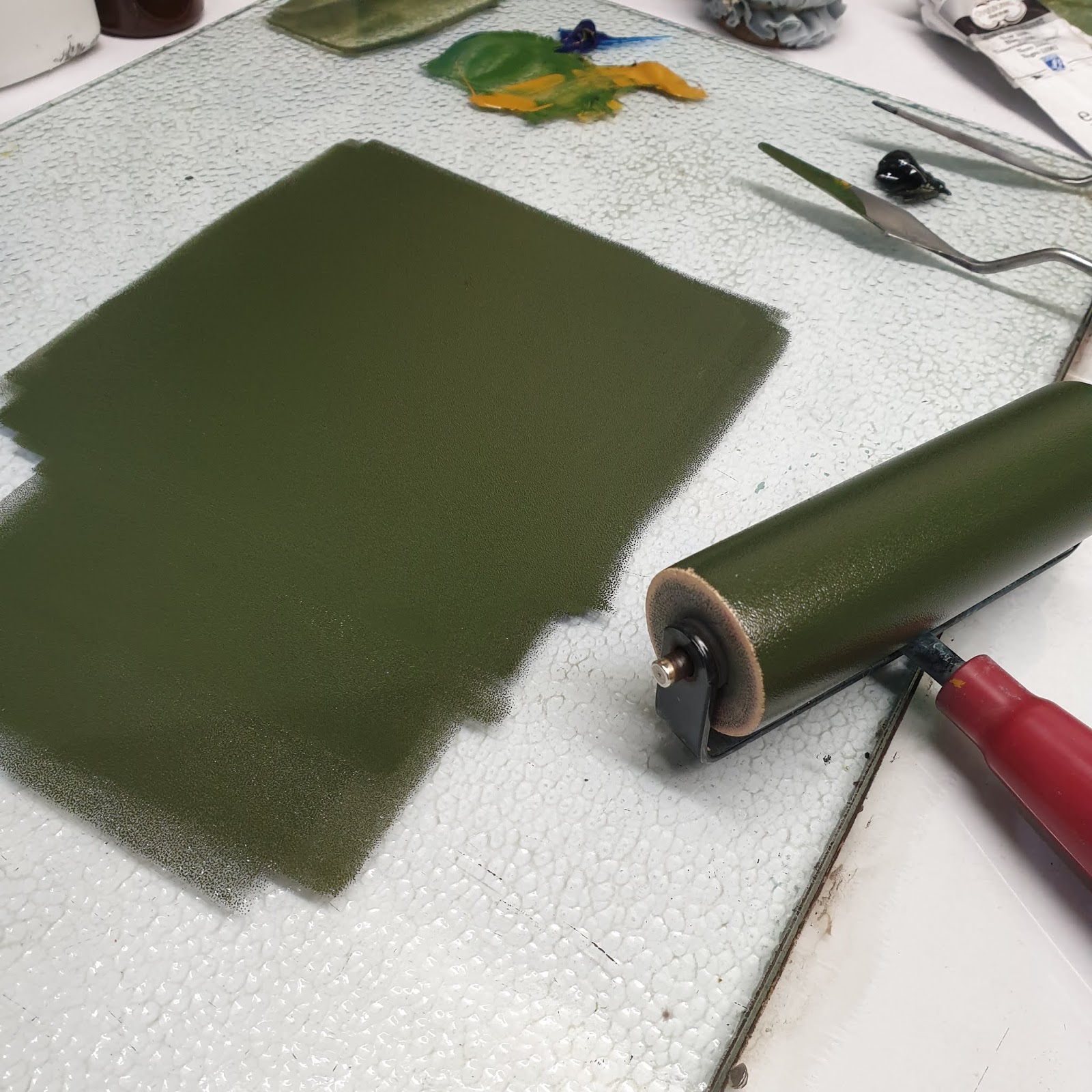
I chose to mix a dark, warm, mossy ink colour for this print,
so although it can appear black in the print, look closely, it's not quite.
(I actually seldom use a straight black ink.)


Toni Hartill
Toni Hartill
Toni Hartill
Toni Hartill
Toni Hartill

Toni Hartill


This was such fun to work on.
Its the first lino cutting I've done since last year as I've been fully immersed in learning to etch aluminium with copper sulphate. I've discovered a deep love for both techniques, which couldn't be more different, but I do so LOVE to carve lino, as this has reminded me. I have some new challenges set for myself to "up my game" so stay tuned.


I look forward to receiving the exchanged prints from the other artists in the group and I will share them in a new blog once they all arrive later in the year.


Many thanks to Celia Walker for organizing this welcomed diversion.


A delighted "Snaily" - sidekick of Toni Hartill


Snaily was certainly chuffed to feature!


Thanks for visiting!


Tuesday, 2 June 2020

PCANZ Small Print 2020 - Exhibition Rescheduled!


Etched aluminium plates. Toni Hartill


"The Small Print" exhibition is an unselected, traveling exhibition of A4 size prints by members of PCANZ (Print Council Aotearoa New Zealand.) This year's initial exhibition was postponed due to the Covid-19 pandemic and the lockdown of the country but now, as we are slowly opening up again, the exhibition has been rescheduled and will now open on

June 8, 2020

at Square Edge Community Arts Centre,
Palmerston North.


All prints are for sale for $100 each.


To see future venues and dates please visit the PCANZ website.


Members were invited to send in up to 4 prints to exhibit.

Below are the prints I submitted for the exhibition.

All are inspired by seedlings of the New Zealand kauri tree, agathis australis,
and are explorations into etching aluminium with copper sulphate.

These prints are made from plates shaped to reference protective glass domes as might be used by collectors or archivists to protect their treasures. I first used this concept last year for my print "Specimen: Manawa" and I made a conscious decision to continue to explore ideas that spring from this concept. (In light of the current pandemic, it seems a strangely apt concept for other reasons - who would have thought?!)

For these initial images of kauri seedlings I was thinking about the many threats the kauri tree faces particularly from Kauri Dieback Disease for which there is no known cure. It is a very scary prospect that we could lose more, or ALL, of our native taonga, this time to disease. Through education and awareness we can all do small things to help make a difference.

Pleases visit the Kauri Dieback website for information and resources
and visit their social media pages for updates.


Copper sulphate etching. Toni Hartill

Etched aluminium plates. Toni Hartill


To visit an earlier post about the making of these prints click here.


"Agathis Australis"

(2 prints submitted)

The celestial background of this print, created using multiple applications of spattered acrylic resist, evokes the night sky and therefore it seemed apt to link the title to the Latin name of the kauri tree, agathis australis; australis meaning south or southern and commonly used to name star clusters. The addition of 4 tiny gold leaf stars, to represent the Southern Cross, was the finishing touch. The ink is a deep, dark blue-black.


"Agathis Australis" by Toni Hartill
Aluminium etching, gold leaf
 Edition of 5, 297mm x 210mm, Hahnemuhle 230gsm

"Agathis Australis" (detail) by Toni Hartill

"Agathis Australis" by Toni Hartill


"Protector of Forests"


The Kauri tree is known to Maori as Te Whakaruruhau - the great protector of the forest - referring to the many species of flora and fauna that shelter beneath the canopy and could not survive without its protection. In this print the title refers both to the mighty kauri as "The Protector" and to the protective dome used to shield the seedling so that it can grow to become a forest giant. "Guilding" the leaves seemed an appropriate mark of respect. This time black ink was used.


"Protector of Forests" by Toni Hartill
Aluminium etching, metallic paint,
Edition of 4, 297mm x 210mm, Hahnemuhle 230gsm


"Protector of Forests" (detail) by Toni Hartill

"Protector of Forests" (detail) by Toni Hartill


"Specimen I"

This was the first image of the series created using the kauri seedling as a protected specimen. Black ink was used and warmth was added to the soil with the application of a little watercolour.

"Specimen I" by Toni Hartill
Aluminium etching, handcolouring.
Edition of 2, 297mm x 210mm, Hahnemuhle 230gsm


"Specimen I" (detail) by Toni Hartill

"Specimen I" (detail) by Toni Hartill

"Specimen I" (detail) by Toni Hartill


If you are in the area I hope you can pop in to view the exhibition
or do visit the PCANZ website to see if it will be coming to a gallery near you.

Alternatively, you can contact me direct if you are interested in either of my prints.
I have a limited number of extra prints available of each.


Thanks for visiting!


Wednesday, 6 May 2020

"Necessity is the mother of invention"


Alison Pickmere, 1968


"Necessity is the mother of invention" is perhaps the catch-cry of many printmakers the world over, particularity here in NZ and one I adhere to in all areas of my life. I think it is part of my DNA.

My mum recently gave me this old newspaper cutting about the NZ artist, and cousin, Alison Pickmere. (Click on the image to enlarge it on your screen.)


Check out that home-made roller she is holding!

I grew up with some of Alison's artworks on the walls of my parents' house. She painted but was also well-known for her printmaking. Having a "real-life artist" in the family was always an inspiration to me but it was the enticing mystery of her prints that helped lure me into wanting to experiment with printmaking myself.


Alison Pickmere, 1966 Photo credit: JWatkins.


The article describes  how Alison was commissioned to create 150 (!) prints for the new Intercontinental Hotel in Auckland, due to open in March, 1968. Most of her works were "semi-abstract and inspired by the artist's love of the New Zealand bush, scenery and coastline."


The article goes on to describe how she went to Paris in 1963 where she studied viscosity printing with the printmaker S.W. Hayter at Atelier 17. Just imagine!


When she returned to NZ "Alison found that it was impossible to obtain the proper equipment and materials for this type of printmaking. In her case, the old saying "necessity is the mother of invention" proved true, and with the help of friends in the engineering, carpentry and printing trades* she gathered enough ideas and materials to make her own rollers, hot plate and etching equipment, all essential to perfect print-making."


* Alison worked as a secretary for an engineering firm for 10 years and she was married to Terry Bond, a publisher, who had studied typography and bookbinding. 


Alison's resourcefulness would certainly have been impressive in 1960s NZ, far from the bright lights of Europe, but it is also completely relatable today (particularly in light of the current global Covid-19 Pandemic. Many people are in "lock-down", away from their studios and/or without access to any art supplies.) Although printmaking equipment and supplies are normally available in NZ, quality or specialist items can still be elusive to track down and are most definitely expensive as compared to in other parts of the world (as I've discovered on my recent trips to Spain, Portugal and Australia. I travel with a wish-list and return with a heavy suitcase.)


Alison exhibited with other well-known NZ artists and some of her works can been found when searching through archives of the country's galleries such as the Auckland Art Gallery.


For an interesting bio about Alison Pickmere please visit:

Te Ara: The Encyclopedia of NZ


For a fascinating webpage about Atelier 17 please visit:

leokatz.com/Atelier-17


One of Alison's works that is most cherished in our family is a page of sketches of my older brother. The story goes that my brother was given paints and a stack of paper to create his own artworks as a means to try to keep him still long enough for Alison to sketch him. Apparently he took his job seriously and frantically worked his way through the entire stash, as can be seen by the sheets of paper surrounding him on the floor. I don't imagine he was a very stationary model.


by Alison Pickmere, 1966


As mentioned, Alison's status as an artist in the family was an inspiration to me in my own artistic endeavours. That and the acquisition of Alison's old laundry mangle, an example of her search for alternative printmaking equipment. The mangle and her old pastel box with well-worn pastels was passed on to me years ago. This coveted mangle lived under our family's pool table for many years awaiting the day that I might finally get around to learning to print.

Initially in my printmaking journey I would lug the mangle upstairs to my kitchen table and was able to block-print small images using a "sandwich" fed through the mangle. It was not an easy task, ideally requiring more hands than I have, but it was effective. The poor old mangle is, and was, in a sorry state and is crying out for a make-over. Meanwhile, I have progressed on to using a more sophisticated mangle conversion and a larger etching press. This mangle no longer gets a look in with my printmaking but it is never-the-less treasured and stored safely away with vague aspirations of restoring it... one day perhaps. 

I wonder how Alison used it?


Vintage art supplies


Alison Pickmere's mangle


Thanks for visiting!


Tuesday, 28 April 2020

Getting to grips with Copper Sulphate Etching - Part 2


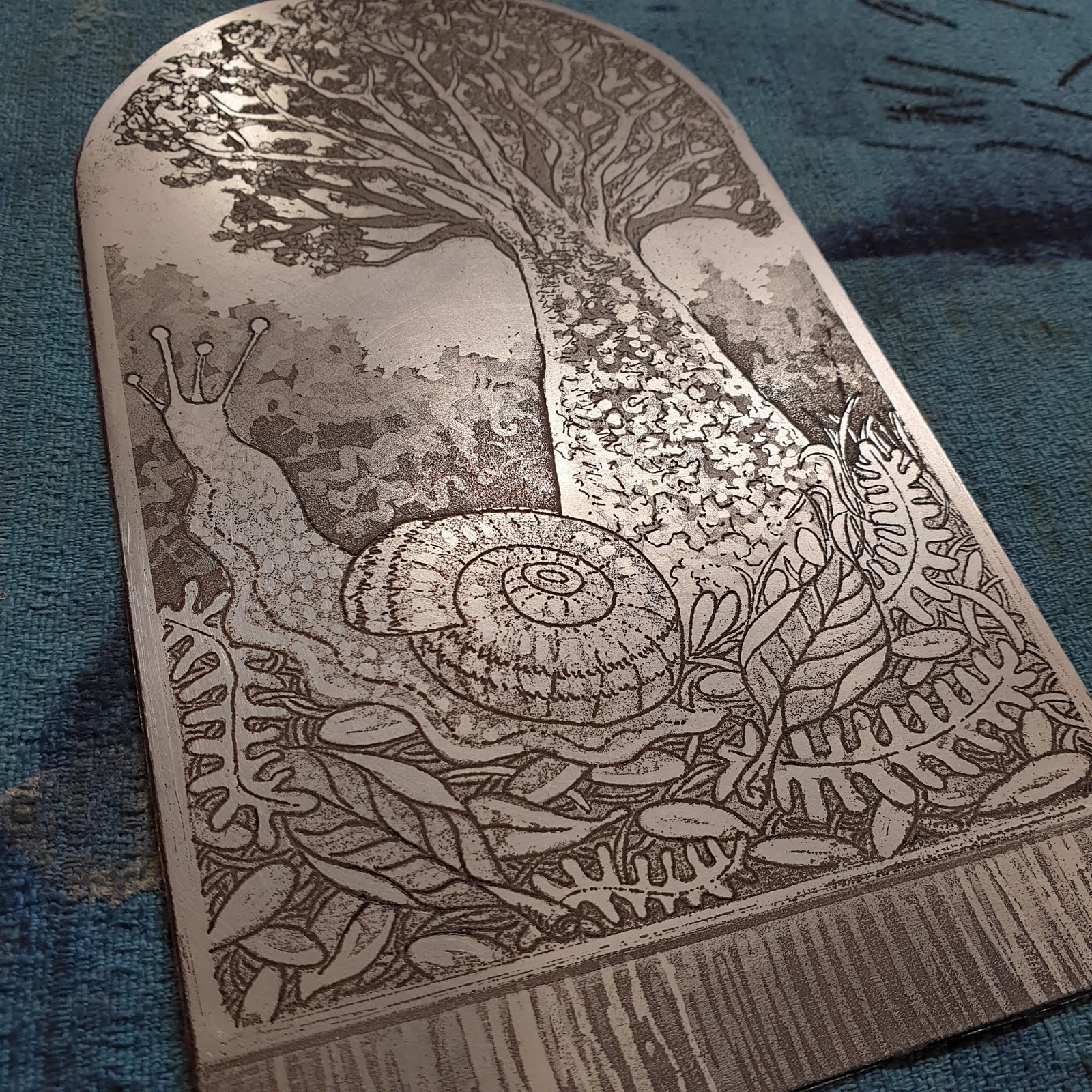
Kauri Snail by Toni Hartill

Continuing on while I'm on a roll, in this post I'll share with you the next series of aluminium plates I etched earlier this year as I have been focused on getting to grips with this etching process - a way of working I have never previously explored and which has fast become my next favourite thing. 
 
Click here to view my earlier post "Getting to Grips with Copper Sulphate - Part 1".


Auckland Gecko 


From a simplified drawing, through multiple visits to the etching bath and finally printing and embellishing with silver leaf. Again, many small discoveries were made which I followed up and retested in subsequent plates, each time challenging myself with the addition of more detail and more purposeful markmaking. The challenge of this plate was to include smaller details and to begin to play with highlights to add depth to the foreground.


Toni Hartill

Toni Hartill

Toni Hartill


Toni Hartill

Toni Hartill

Toni Hartill


Toni Hartill

Toni Hartill


Toni Hartill


Toni Hartill


Toni Hartill
 

Toni Hartill

Toni Hartill


An unexpected bonus with this wee chap is the "scaliness" of his skin. 
Something to remember and play with further.

Toni Hartill


NZ Morepork - Ruru


The challenge in this plate was to create a more "painterly" abstract background that "read" as foliage to try get a sense of depth into the background of the image. This required, again, multiple reapplications of resists to gradually build up the deeper tones and patterning. Scary, worrying about ruining what's already there, knowing when to stop!


Toni Hartill

Toni Hartill

Toni Hartill

Toni Hartill

Toni Hartill

Toni Hartill


Toni Hartill

I was really delighted to see the wee ruru even managed to have a hint of a tiny glint in his eye! 
Bless his fluffy wee pompomness!

Toni Hartill


And another small edition while I'm in the "zone".


Toni Hartill


And Snaily makes Three!


 This time I wanted to put some of the things I had learnt to the test and include even more detail: lots of linework in the foreground, a "painterly" background and I wanted to try to achieve some interesting textures for the Kauri trunk and ol' Snaily's complexion.

Toni Hartill

Toni Hartill

Toni Hartill

Toni Hartill

Toni Hartill

Toni Hartill

Toni Hartill

Toni Hartill

I needed to tweak some details so they read better against the background. 
Takes a bit of fiddle and concentration! Good to know its possible to be this exacting though.


Toni Hartill

Toni Hartill

 And a final test print.


Toni Hartill


These 3 images are destined for a project which, in light of the current Covid-19 situation, is still scheduled to happen but at a slightly delayed date. Check back for updates. 

I have editioned both Gecko and Ruru but I am holding off editioning Snaily til I have replenished my ink supplies. Especially as I am now trying to work towards a closer deadline of a group show in June, and hence I am feeling "frozen" about using up my precious supplies when I need plenty to "play" with. While others were out panic buying toilet paper and flour I should have been hoarding INK and PAPER!


Toni Hartill

I have since prepped another batch of plates but they will have to wait while I am tinkering and attempting to generate new ideas for work for my group show. This work so far is completely different, inspired by our current predicament of being in "lockdown"and so tuning my outlook to what is close to hand. Its raising interesting thoughts and ideas... 


Toni Hartill

Toni Hartill


Check back later for a new post about my progress 

or follow me on Instagram 


for more regular "work in progress" shots.


Thanks for visiting!

Stay safe and well
Arohanui